How Eight Sleep Sells a $3,000 Pod With Almost No Urgency
39 Eight Sleep emails: one doubt per send, Affirm and HSA/FSA doing the price work, and deadlines living in footer fine print.
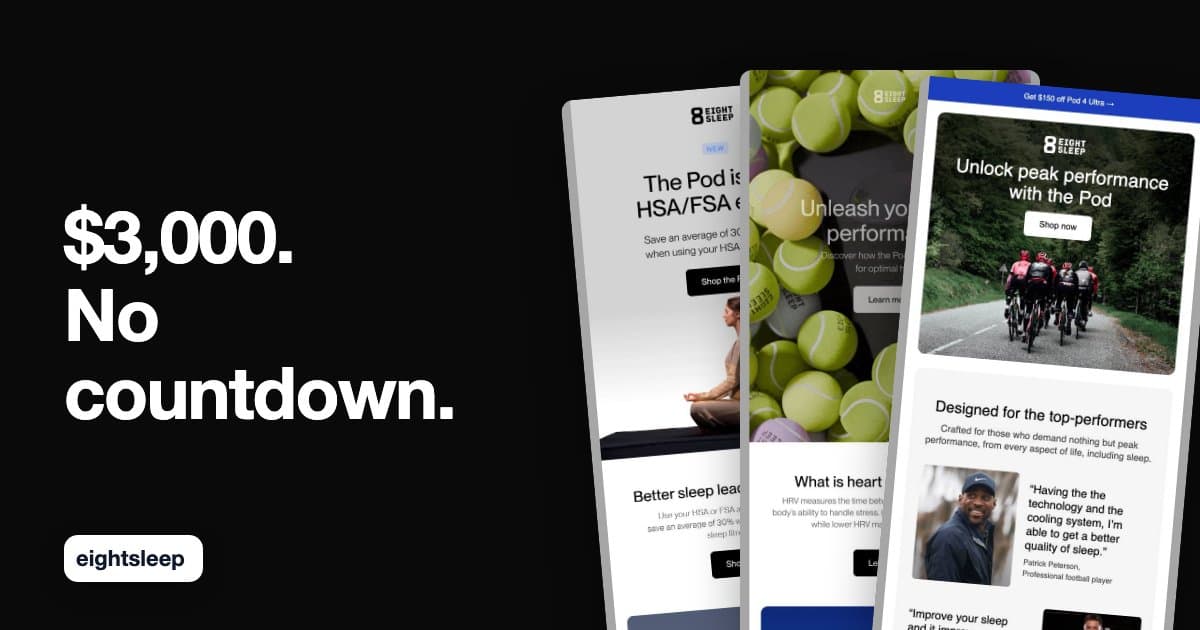
The Pod is a smart mattress cover that heats, cools, and tracks your sleep. It costs $2,000–3,000+. High-ticket email usually leans on countdowns — Eight Sleep barely uses one.
A note on scope first: we read 39 Eight Sleep emails for this piece — a 2024–26 flow capture across five signup paths, plus the April–May 2026 campaign stream. That's a slice of the corpus, not all of it, so everything here is scoped to those 39.
Inside that slice, the pattern holds steady: one doubt per send, financing doing the price work, and deadlines that live in footer fine print.
October 2024: one doubt per send
In October 2024 the objection handling ran as a broadcast wall. Seven campaigns between Oct 8 and Oct 20, each taking exactly one doubt.
Price got two of them: an HSA/FSA email (“Save an average of 30%” — pre-tax dollars, the biggest savings number in the set, and it costs the brand nothing) and an Affirm email (“Sleep now, pay later.” / “Checking your eligibility won't hurt your credit score”).
Proof got an HRV explainer (“clinically proven to increase HRV by up to 19%”) and a sleep-gain chart with an Andrew Huberman quote. Status got named athletes. Partners got the snoring email.
Here are six of the seven:
None of the seven has a deadline in the body. Where an offer appears, it's a “$150 off Pod 4 Ultra” banner with “*Requires the purchase of Enhanced Autopilot” in the footer — and no end date appears anywhere in the 2024 set.
The seventh broadcast is our favorite. “Arguing in bed?” takes the skeptical-partner objection: three quoted partner complaints, then an “Is your partner skeptical?” risk-reversal card. It's the only email in the 2024 set with no offer surface at all.
Eight Sleep
Arguing in bed?
OpenIts footer disclaimer reads “Results not guartenteed.” A typo shipped in a broadcast — a small reminder that a human built this.
The cart nurture never raises the offer
We also left a Pod in a cart on the special-offer path. The first cart email arrived 64 minutes after our abandonment: an extra $50 off with code EMAIL50, plus Affirm at “as low as $71/month.”
The day-3 closer carries the identical $50. What changes is the argument — the Fast Company pull-quote is swapped for “Try it risk-free for 30 nights… full refund. We'll even cover shipping.”
The closer's subject warns “Don't let your special offer go to waste.” The body shows no deadline. The escalation is reassurance, not a bigger number.
Risk never gets its own email
Notice what's missing from the objection wall: risk. In these 39 emails it never gets a dedicated send, in either era.
It doesn't seem to need one. A near-identical trust bar closes every email — 30-night risk-free trial, free shipping and returns, 5-year warranty, financing. Three items across the 2024 emails, four icons across the 2026 campaigns.
In the sends we checked, the bar drops to three icons when a dedicated Affirm card replaces the financing icon. The template answers the risk question at the bottom of every send, so no single email has to.
April 2026: the wall becomes a rotation
Eighteen months later, the same matrix runs as a near-daily rotation. Athlete proof, clinical stats, dual-zone partner pitch, payment options — one persuasion job per email, cycling.
These are campaigns, so the clock is the brand's choice: sends land at :00–:03 past the hour, overwhelmingly 15:00 UTC, day after day.
By 2026 the subject lines carry a notation system. Results-flavored subjects end in an asterisk that resolves to footer fine print: “*Individual results vary and may not be guaranteed.”
The gap is visible in the clinical send. The subject states “Clinically proven: 34% more deep sleep” flat; the body softens it to “Up to 34%…*”. The subject is stronger than what the footer stands behind.
The offer ladder keeps its deadlines in the footer
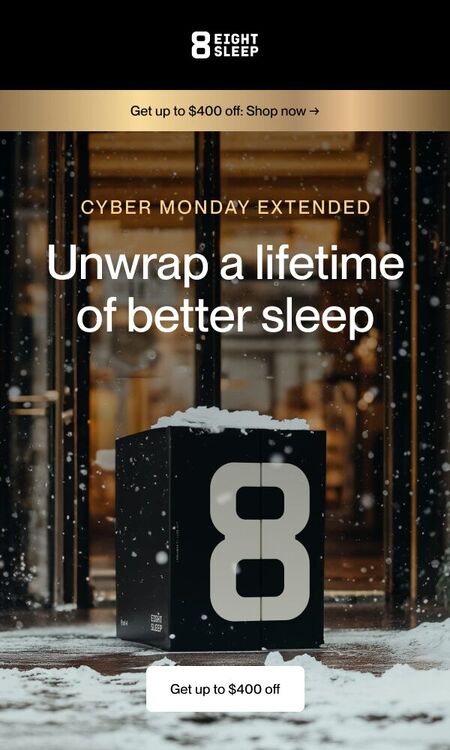
April's only offer is a flat $100 off. No code — “Discounts apply automatically at checkout.” No deadline. The fine print calls it an “*Email exclusive offer” every time it quietly recurs: Apr 9, Apr 13, Apr 18.
Even month-end stays restrained. The Apr 30 send puts “Last chance for $100 off this month” in the subject; the body never names an end date.
Then May escalates. Mother's Day brings “Up to $300 off* through May 10” — the deadline appears in body copy once, on May 2, then retreats to footer fine print (“Offer ends May 10th 11:59 PM PT”) for the rest of the window.
The May 10 send goes out on deadline day and never says “ends today.” One day later: “Up to $600 off… the best offer of this season,” plus a limited-time 0% APR, 36-month Affirm offer. The May 31 end date lives only in the footer.
That's a 6x escalation in about five weeks, announced at open (“starting today”, “ends soon”) and never dramatized at close. Why hide the deadlines? Only Eight Sleep knows — but the pattern is consistent across the whole window.
Through the whole ladder, the harder-worked price lever isn't the discount. It's payment plumbing: Affirm at “$78/mo,” HSA/FSA pre-tax dollars via Truemed, and an energy-bill angle (“Cool sleep, lower energy bill”). The financing cards get more real estate than the end dates.
For completeness: we did catch one hard deadline, in February 2026. A popup-path signup got “This offer ends at midnight*” about two hours after the welcome — sent 13 hours before a real, footer-stated end time. It may simply be the month-end sale landing on our first day rather than a welcome tactic — either way, it's the only hard deadline in this sample.
What we noticed
- Within these 39 emails, urgency is nearly absent: zero body deadlines in all of 2024, an open-ended $100 through April, and a deadline-day send that never says “ends today.”
- Price gets worked through payment framing — Affirm monthly pricing, HSA/FSA pre-tax dollars, energy bills — more than through bigger discounts. The 2024 cart closer swaps in risk reversal instead of raising the $50.
- Risk is handled by the template, not the calendar: the same trust bar closes every send, so no email has to be the reassurance email. Whether all this beats countdowns, only Eight Sleep knows.